[ AxiomCore · Documentation ]
Axiom Inspector
Query what an Axiom application declares, resolves, can access, executed and changed, from the CLI or a local dashboard.
Axiom Inspector turns compiler, resolver, package, authority and runtime evidence into a queryable model of your application. Use it to answer four questions:
- What is this application?
- What can it do, and why is it allowed to?
- What happened during one captured execution?
- What would a change affect?
It works on frontend-only, backend-only or combined workspaces.
Begin with available evidence.
Acore source, verified contracts, locks, packages, authority, and captured runtime events contribute different evidence. Missing evidence remains explicit.
Evidence sourcesThe CLI, machine formats and dashboard all query the same evidence engine with the same semantic IDs and graph revision. The dashboard does not reimplement the compiler, and an AI explanation never becomes a new source of facts.
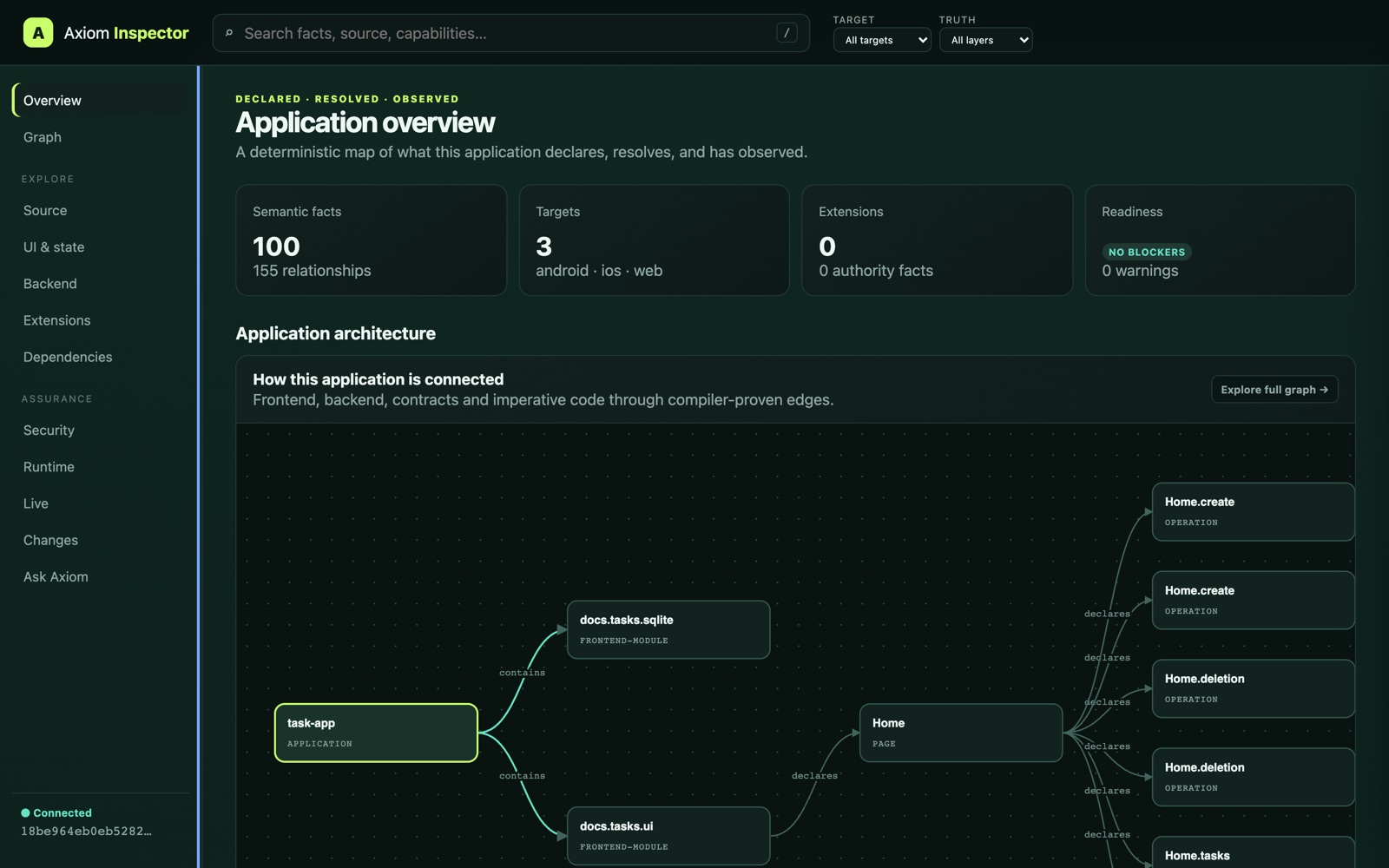
The dashboard Overview for the documentation task app, served by CLI 0.149.1.
Start locally
From an application workspace:
axiom inspect overview .
axiom inspect serve .
The first command prints a summary of every discovered fact. The second starts
the loopback dashboard. For agents and CI, add
--format json (one complete result) or --format jsonl (one record per line).
What you can inspect
| Area | Commands | Examples |
|---|---|---|
| Workspace | overview, source, serve | Every discovered fact, one saved source file as the editor sees it, the dashboard |
| Frontend | frontend, ui, state, styles, accessibility | Routes, pages, components, primitives, actions, state, queries, mutations, styles, responsive branches, assets, accessibility |
| Backend | backend, operation, data, exposure, cache, server | Services, operations, endpoints, models, fields, projections, validation, auth, errors, cache, retry, streams, implementation bindings, private server plans |
| Contracts and packages | dependencies, contract, executable-closure, provenance | Direct and transitive imports, immutable identities, target support, provenance, executable closure; extension exports, digests, permissions, limits and source availability |
| Security | security, authority, finding, readiness, access | Exposure, requested, granted and effective authority, findings, blockers |
| Relationships | node, evidence, trace, why, reachability, lineage, graph, query, target-compare | Typed paths between facts, per-target differences |
| Runtime | record, runtime, export-audit, import-audit | Redacted sessions, traces, extension lifecycle, denials, state changes, cancellation, teardown, retention |
| Changes | snapshot, validate-snapshot, diff, impact | Semantic changes, approval classes, bounded impact paths |
| Questions and handoff | ask, answer, export-inspector, import-inspector, release-check | Bounded questions, signed offline exchange, Inspector self-checks |
The axiom inspect reference lists all 46 subcommands.
Inspector reports evidence, not guesses
Inspector states only what its current evidence establishes. It does not infer an external backend implementation from an endpoint name, label static reachability as an observed call, or treat requested extension authority as a grant. When evidence is unavailable or a traversal is truncated, that limitation is part of the result.
Inspector keeps its local state under .axiom/inspector/ in the workspace: a
query cache, snapshot copies, runtime sessions, planner receipts and the live
connection descriptor. Inspection makes no hosted upload.
Recommended development loop
- Run
axiom inspect overview .after adding or importing a contract. - Review dependencies, executable closure, security and authority before accepting third-party content.
- Trace important actions and operations in both directions, with the dashboard open while you develop.
- Capture runtime evidence only when a question needs observed behavior, and gate CI on semantic diff between snapshots.